
Maximizing Returns Doesn’t Always Mean Better Outcomes
Many investors are taught to think in one dimension:
Higher expected return = better outcomes.
But real life doesn’t happen in averages. You don’t get an “expected” outcome—you get one path, one sequence, one start date, and one set of emotions along the way.
That’s why a portfolio with a higher expected return can still lead to a worse outcome—especially when volatility shows up at the wrong time causing sequence of returns risk.
The goal isn’t to “maximize returns.”
The goal is to optimize outcomes: fund the life you want, with a high probability of success, without relying on perfect timing.
Volatility isn’t just uncomfortable — it changes the math
There are two practical reasons volatility can change results:
1) Big losses create long recovery windows
A -50% decline requires a +100% gain to recover. Even if markets rebound eventually, the recovery window may collide with your timeline (retirement, a home purchase, college funding, etc.).
2) Sequence of returns risk (the order matters when withdrawals start)
When you’re contributing for decades, volatility can be manageable (even helpful).
But when you’re withdrawing, volatility becomes dangerous: bad early returns can force you to sell more shares at depressed prices—leaving fewer shares to recover later.
That’s sequence-of-returns risk in plain English:
The first several years can dominate outcomes.
A real-world side-by-side: retiring in 2000 vs retiring in 2003
Let’s compare two real retiree “cohorts” who did the same thing—invested in the stock market and took withdrawals—but started just three years apart.
Cohort A (2000 retiree): withdrawals start in 2000
Cohort B (2003 retiree): withdrawals start in 2003
Assumptions (kept intentionally simple)
Starting portfolio: $1,000,000
Withdrawals: $50,000 in year 1, then increase with inflation each year
Withdrawals taken: end of each year
Annual rebalancing (for mixed portfolios)
This is not meant to be a perfect retirement model (taxes, fees, and real-world behavior matter a lot). It’s meant to isolate one concept: sequence risk.
100% stocks: the same strategy, wildly different outcomes
Result after 20 years (inflation-adjusted withdrawals):
2000 cohort (2000–2019): portfolio depleted during 2017 (ending balance: $0)
2003 cohort (2003–2022): ending balance: ~$3.0M
Same “strategy.” Same withdrawal rule. Same index.
Different result—because the sequence at the start was different.
What the first few years actually looked like (the “sequence”)
Here are the first three years of S&P 500 total returns (dividends reinvested) for each cohort:
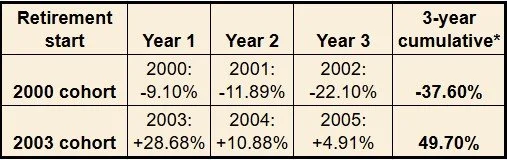
*Cumulative = compounded return over the three-year sequence.
If you’re withdrawing from the portfolio, those early years matter disproportionately. A bad early sequence forces you to sell more shares while prices are down—leaving fewer shares to recover later.
This is why “100% stocks” can look great in hindsight… and still be a fragile plan if the first few years go against you.
Adding a stabilizer: 70/30 vs 100% stock
Now let’s rerun the exact same scenario, but with a 70/30 portfolio:
70% stocks
30% high-quality bonds
rebalanced annually
What happened?
For the 2003 cohort, 100% stocks finished with a higher ending balance (in hindsight, the risk “paid off”).
For the 2000 cohort, 100% stocks didn’t just underperform—it failed, depleting by 2017.
The 70/30 portfolio didn’t maximize upside… but it reduced the chance of a catastrophic outcome.
20-year ending balances (inflation-adjusted withdrawals):
2000 cohort (2000–2019)
100% stocks: $0 (depleted in 2017)
70/30: ~$383k remaining
2003 cohort (2003–2022)
100% stocks: ~$3.0M remaining
70/30: ~$2.0M remaining
That’s the tradeoff between maximizing returns and optimizing outcomes:
100% stocks offers more upside if you retire into a favorable sequence.
A balanced portfolio narrows the range of outcomes and reduces the odds of a plan-breaking scenario.
Important: I’m using a 70/30 stock/bond mix to illustrate the tradeoff between upside and a narrower range of outcomes. It’s not a universal recommendation—appropriate allocations vary based on time horizon, spending needs, and risk tolerance.
We can’t know our sequence ahead of time
In hindsight, the “right” choice is obvious.
In real time, it isn’t.
Nobody retires knowing what the next 3–5 years will look like. That’s why portfolio design should be less about selecting the highest expected return and more about building a plan that remains viable across many possible market paths.
Optimizing outcomes means you can be wrong about the sequence—and still be okay.
Practical takeaway: match risk to the job the money needs to do
If you’re 25+ years from retirement and still accumulating, you can afford a wider range of outcomes.
But if you’re:
within ~5–10 years of retirement,
already retired and withdrawing, or
funding a goal with a deadline,
…then controlling downside and avoiding forced selling matters more.
A more conservative allocation isn’t “giving up on returns.”
It’s buying a higher probability of meeting your goal.
The punchline
Maximizing returns is a spreadsheet goal.
Optimizing outcomes is a life goal.
The best portfolio isn’t the one with the highest expected return.
It’s the one that gives you the best chance of funding the life you want—even if you retire into the wrong decade.
Disclaimer: Educational content only — not investment advice. Investing involves risk, including loss of principal. Examples are hypothetical/simplified and based on historical data; past performance is not indicative of future results.
Meet Your Guide

Hi, I’m Josh Short, a CERTIFIED FINANCIAL PLANNER® professional and founder of OptimalPath Advisors. With over 20 years in financial services, I help DIY investors and FI-minded professionals build clear, flexible plans—using flat-fee, commission-free advice.
Want a Portfolio That Works Even If You Retire Into the “Wrong” Decade?
It’s easy to design a plan that looks great in hindsight. The harder (and more valuable) work is building a plan that still holds up if markets deliver a rough early sequence—because none of us know ahead of time whether retirement starts in a “2000” or “2003” scenario.
I help clients:
Build a simple, rules-based investing plan (allocation, rebalancing, and what to do when markets get ugly)
Design a retirement spending strategy that reduces forced selling (withdrawal rules, cash/bond buffers, guardrails)
Stress-test for real-life sequences (bad first decade, inflation spikes, early-retirement bridge years)
Coordinate investing + tax planning to improve after-tax outcomes (Roth conversions, account drawdown order, Social Security timing)
Align the plan with your goals so you can spend confidently now and later
I work with clients locally in East TN and virtually across the U.S.
If you’d like help building a plan that optimizes outcomes—without guessing the market—schedule a free 30-minute intro call here:
https://calendly.com/josh-optimalpathadvisors/30min
See if flat-fee planning is a fit for you: https://www.optimalpathadvisors.com/pricing-1
Meet the advisor + learn how I work: https://www.optimalpathadvisors.com/aboutus
